Showing posts with label roger zelazny. Show all posts

Wednesday, August 4, 2010

Book Review -- THE GUNS OF AVALON by Roger Zelazny

Several months ago, I slammed through this short book and intended to write a review on it, but never did get around to it. Zelazny's first volume, Nine Princes in Amber, I have already reviewed here. It's a pretty short novel, running only about 223 pages in length, so it's pretty typical of a mid-20th century fantasy/science-fiction novel in that regard.

If you've read my comments on Nine Princes of Amber, then you'll know what to expect here. Zelazny mixes a lot of literary styles, but seems to focus primarily on the fantasy aspect of the series in this novel. Corwin, our protagonist, still talks like a hardboiled detective at times, and at others like a knight from an Arthurian romance (occasionally in the same sentence), but as I stated in my other review, this is just a feature of Zelazny's setting, not an anachronism. His prose isn't fantastic, though he occasionally shines in certain places. He writes with the fast-paced rhythm of the pulpy adventure that dominated so much of the 20th century. His descriptions are sparse, almost anti-Tolkienesque in flavor, leaving much to the imagination of the reader. He focuses more on describing fencing technique and combat, or clothing and accessories, than he does location or setting.

As for the story itself, it picks up shortly after Nine Princes of Amber ended. When we last left Corwin, he had vowed to claim his brother's throne and see guns brought to Amber--a place where gunpowder does not ignite. But Corwin has a plan, and the bulk of this book focuses on how he carries this plan to fruition.

If that were all, the book would be hum-drum, but Zelazny set up a wrinkle at the end of Nine Princes when it appeared that a new road to Amber had opened up through Shadow--one related directly to Corwin's curse that Eric's reign would not be easy or peaceful. Throughout the book, Corwin must confront the consequences of his curse, which appear to escalate in intensity to the point of nearly causing him and his brother Benedict to fight to the death. The full impact of his short-sightedness and selfish behavior do not make themselves fully clear until the very ending, when Corwin faces something that could potentially destroy Amber and bring Chaos to the entire multiverse that Amber governs.

Corwin is something of a scoundrel, an ultimately selfish and narcissistic character, but then again, so are all of his siblings. He is very typical of the 1960s-70s fantasy anti-hero, cut from a similar cloth as Moorcock's Elric. However, Zelazny is not about to let him get away with it, and Guns of Avalon is about reaping what one has sown. Throughout the novel, Corwin travels through lands and encounters people where his past threatens to catch up with him, and his current deeds will bring consequences before the novel ends. Despite all of the challenges he face, the greatest threat to Corwin isn't from the darkness that cuts through Shadow, or from his brothers, but from himself and his own indiscretion.

In the end, Corwin triumphs, but his triumph is hollow and meaningless, because he is inheriting the very curse that he bequeathed upon his brother. Corwin conquers every challenge set before him except those he has set before himself.

This novel is very obviously a bridge. It's setting up the next installments, wherein Corwin will undoubtedly confront his own creations and face the consequences of his actions and his decisions.

But none of this should suggest that Corwin is not a sympathetic character. He's an Amberite--he is stronger, faster, and more intelligent than people who live in Shadow. He has lived for centuries, and in those centuries perfected his combat abilities and his knowledge and skill in military affairs. As a strategist, he is second only to Benedict, his elder brother and former warmaster of Amber. There's good reason for his aloofness and narcissism. During his sojourn on our Earth, Corwin had learned that beings from Shadow were not simply toys or mindless dolls to manipulate, but that we had feelings and were fragile in mind, body, and heart. Corwin had learned this by the beginning of Nine Princes but he hadn't quite gotten over his narcissism, and, indeed, by his treatment of his lovers, one can see that he still has a way to go.

As with Nine Princes, the author's inspiration is eclectic. Zelazny takes us through worlds invoking chivalric romance and Arthurian legend, on chases through strange landscapes, and a brief jaunt to 20th century Earth. Great squadrons of mounted knights charge into monstrous hordes of foul beasts, evil creatures cackle in dark towers, and heroes with shining swords do battle against the forces of chaos. Like most of the pulpy fantasy writers of the 50s, 60s, and 70s, the great enemy isn't simply evil, but is chaotic (this would come to heavily influence Gary Gygax and Dave Arneson in their creation of fantasy role-playing games, such as Dungeons & Dragons). The final chapter features modern riflemen engaging in a decisive battle that could remind readers of Jared Diamond's Guns, Germs, and Steel. The book is, like its predecessor, an exciting journey through imagination--something that pulp writers do best. It's not a work of amazing literary merit, but it is surreal enough to be thoroughly magical.The Guns of Avalon by Roger Zelazny
Style B
Substance B
Overall B

Wednesday, July 21, 2010

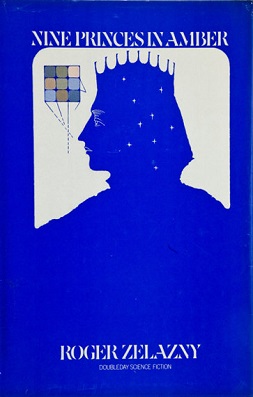
Book Review -- NINE PRINCES IN AMBER by Roger Zelazny

A man wakes in a hospital bed with no memory, except the knowledge that he's been kept drugged up for quite some time. He doesn't know why, but he's determined to escape and find out. Thus begins a fast-paced, imaginative adventure that is, in many ways, emblematic of the new wave in science fiction and fantasy. It starts off almost like a hardboiled detective novel, and indeed, there are certain character elements (including first-person narration) that seem lifted directly from a Raymond Chandler story. But it is dynamic and imaginative fantasy nevertheless.

If you haven't heard of Amber, nor read any of Zelazny's Chronicles, then I'm loath to give away any of the story. So I'll try to cut out as many of the spoilers as humanly possible while still discussing the strengths of the book.

First, the tone shifts back and forth between dense, chivalric language and modern slang, almost to the point where it can be quite jarring:
"I did not know this," I said. "My memory is so screwed up. Please bear with me. I shall miss Benedict, an' he is dead. He was my Master of Arms and taught me of all weapons. But he was gentle."
"Screwed up" right beside "an' he is dead," this mixture of wording and idiom can be somewhat shocking, but it actually makes sense, given who the protagonist is, and shows that Zelazny is actually a much more versatile writer than we think.
I walked among Shadows, and found a race of furry creatures, dark and clawed and fanged, reasonably manlike, and about as intelligent as a freshman in high school of your choice--sorry, kids, but what I mean is they were loyal, devoted, honest, and too easily screwed by bastards like me and my brother. I felt like the dee-jay of your choice.
It makes perfect sense that the protagonist's long sojourn on our Earth (and in the United States, for a time) has had a profound effect on his thinking. As the novel develops, we can see that the main character's fondness for our world has changed him on a number of quite fundamental levels. Yes, given his ultimate background, he has every reason to be haughty, superior, and to see the average person as little more than servants and/or cannon-fodder. However, his experience has given him compassion and empathy, and as he regains his memories, we learn what horrible tragedies he has seen, the wars he fought in, and the agonies he has suffered. These experiences set him apart from the others like him, and give him a deeper understanding of the "little guy."

This mixture of language styles and idioms supports the idea that the hero is caught between two lives--the one he ultimately lived in, and the one he recently experienced on our Earth (right before he awakes in the hospital bed). His character could be simply flat and static, and in many ways, he might seem so. But Zelazny's use of idiom and his subtle reminders of the protagonist's past experiences (through brief flashes of memory), as well as his compassion for underlings, creates a stark contrast between him and his peers.

Due to the brevity of the work, the other characters don't get much time to develop, but Zelazny does a good job with the barest of spaces that he uses. For example, Random lives up to his name--he's impulsive and unpredictable; Moira comes off as cool, in control, confident, and serene; Eric as hard, determined, and ruthless. Other characters, however, don't come off so well. Deirdre could be played by Random Blonde #5, and Caine and Gérard are poorly defined and very interchangeable, but they could all be much better depicted in later books. The characters are all pretty archetypal at this point in the tale, but the book is only 175 pages long so I guess it can be excused.

Zelazny is also quite light on the description, so your mental pictures are a bit smoky and ill-defined. The magnificent city of Amber only gets a brief sentence of description when seen from a distance, which will be quite surprising and perhaps disappointing to readers weaned on Tolkien or Robert Jordan.
The mountain that faces the dawn, Kolvir, which has held Amber like a mother her child for all time, stood perhaps twenty miles to our left, the north, and the sun covered her with gold and made rainbow the veil above the city.
You really don't get much more than that. Zelazny doesn't want to slow down his story for the sake of description, but that means that your mental picture is little more than a pencil-sketch without a lot of color. You have to fill in most of the image.

What Zelazny does describe are events--especially fights. The reader would be advised to brush up on some of his fencing terminology, because Zelazny uses it, frequently during sword-fights. His action is fast, bloody, and brief, but you can easily visualize the swashbuckling style that made guys like Errol Flynn famous. There is one sword-fight that takes place in a library that is only a few pages long, but is far, far more exciting than reading a Robert Jordan duel, which ends up being a list of inscrutable blade techniques with names like Lakota chieftains.

The use of amnesia and the regaining of memories serves as a great vehicle for introducing the world and the setting to the readers, rendering info-dumps as an integral part of the storyline and making them far more interesting to the reader and more emotionally meaningful to the protagonist.

Many refer to The Chronicles of Amber as Zelazny's magnum opus, and I can certainly see this being a solid foundation for such a work. The book is populated with allusions to history and literature, which make the story both familiar and new at the same time. For example, the Forest of Arden is lifted from Shakespeare's As You Like It, and there are elements of the War of the Roses infused in the rivalry for the throne of Amber. The Trumps themselves make for a great setting/story element. Each turn of the pages reveals more and more of Zelazny's mysterious universe.

Good fantasy, like good science-fiction, is often about the imagination, and the creation of believable systems that enable the writer to do whatever he/she wants. Zelazny's book is a pretty good flight of fantasy. Unfortunately, character depth isn't all that impressive for the most part, and Zelazny's lack of description is somewhat disappointing, because when he does decide to describe something, he seems to do so effectively enough:
The archway loomed ahead, perhaps two hundred feet distant. Big, shining like alabaster, and carved with Tritons, sea nymphs, mermaids, and dolphins, it was. And there seemed to be people on the other side of it.
How much does Zelazny really need to say about an archway? He sums it up with two sentences. But something like the city of Amber itself deserves a bit more. The strength of this pulpy language is to keep the story moving and keep the reader interested. But I feel as if there were areas where more description was warranted, even if it did slow down the narrative a bit. Zelazny wisely chooses to explain why Amber is so magnificent and wonderful through the actions, words, and thoughts of the character and keep the story flowing. However, we could certainly benefit from a more extensive physical description of its magnificence. I honestly must say that I have no idea what Amber is supposed to look like, except that it's on a mountain and beautiful. Maybe gold. I could tell you all about what it represents, but I really can't say a single thing about what it looks like. For something so central to the story, I feel that it deserves a bit more.

All together, this is a fairly solid, pulpy book and a decent contribution to the swashbuckling angle of the sword & sorcery genre. It's certainly a fine example of "big concept" writing (with Amber itself being the concept), and it's full of action, suspense, and atmosphere galore. Zelazny writes events and situations remarkably well, and he certainly is a master at creating atmosphere and tone, but he makes an Iphigenia of physical set descriptions in order to propel the plot forward on winds of action and suspense. Nevertheless, it is definitely recommended.

Nine Princes in Amber by Roger Zelazny
Style B+
Substance B
Overall B