Showing posts with label old school renaissance. Show all posts

Wednesday, February 9, 2011

My Short-Lived Conan Campaign

Back in graduate school, I had barely enough time to run a very short-lived Hyborian campaign, using the D20 Conan the Roleplaying Game rules from Mongoose Publishing. Conan is not the kind of setting that an OD&D game would really fit well with, I'd think. Why? Well, simply because OD&D seems more at home with a mega-dungeon. Reading through James' Dwimmermount posts at Grognardia, Justin A.'s reactions to OD&D at The Alexandrian, and reading through the White Box rules myself, I've come to the conclusion that OD&D is more at home in the mega-dungeon than anyplace else.

Yeah, Robert E. Howard is a huge influence on OD&D, and the pulpy stories that he and others (like Fritz Leiber) wrote, with scoundrels and ne'er-do-wells adventuring for quickly-spent fortunes being at the heart of the game's flavor--but that flavor is also very much effected by the mega-dungeon, something that Robert E. Howard and Fritz Leiber do NOT dwell on. Dungeon settings pop up in their stories, but never one huge, oft-revisited, re-delved, evolving labyrinth.

A Hyborian adventure lends itself to two types of games, in my opinion--the city game or the wilderness game--exact opposites of what the mega-dungeon game involves. In the mega-dungeon game, the sandbox approach works incredibly well. The players and DM together, through play, create the world. There are maybe one or two bases of operation, and one big, bad dungeon that is repeatedly delved, deeper and deeper each time. But the city and wilderness games require a more definite approach.

I ran my game in Shadizar, capital of Zamora and City of Wickedness. The city game needs a pretty detailed setting, so I went to mine ideas from the Shadizar--City of Wickedness boxed set by Vincent Darlage. Yeah, I don't recommend it. The original map for the book was a joke, and the setting details were completely culled from pastiche sources, like the cheesy Conan books by Robert Jordan and the comic books. Now, I'm not knocking the pastiche, but it's not Howard, and honestly, if it's not going to be Howard, it may as well be cooked up in Darlage's own head. All of the locations were all taken from the pastiche books, all the gods from the comics, and none of it was Darlage's. There was a single adventure in there, entitled "Dark Dens of Iniquity." At its core, there could be a decent adventure. You have some interesting characters with neat motivations, but the adventure itself is basically the PCs being railroaded from one encounter to the next with really very little coherent plot development--as a railroad adventure "Dark Dens of Iniquity" even failed! But there were some really good feats (like "Eyes of the Magpie") and a few decent prestige classes in the books to make it worthwhile, plus a few tables on slaves, kidnapping, and prostitution that could be useful. And Mongoose had the good graces to produce a better map of the city for download on their website.

So, I decided to bust out my trusty pen and pencil and completely rework the adventure and city from the ground up. I spent money on the boxed set, and thankfully, a second map was released online for me to download and use. I mined some other sources for ideas, namely the Scarred Land's Shelzar--City of Sins (the similarity in names is NOT a coincidence), Planescape's In the Cage--A Guide to Sigil (for general weirdness), Dark Sun's The City-State of Tyr (for the harshness of setting), and the Forgotten Realms' City of Splendors boxed set (the 2nd edition masterpiece, not that 3rd edition abortion of a crunch catalog). I went through some of Robert Jordan's pastiche books for some locations and characters that Darlage didn't include. And I wrote up pages of notes on the pantheon, factions, politics, people, and locations throughout the city--notes that I can still pick up anytime I want to try and run a Shadizar game again (and I fully intend to do so when I return to the States from Korea). I had neighborhoods mapped, a few inns, merchants' homes, noble houses, and caravanserais.

My kind of sandbox is a bit different from many of the grognards' sandboxes--the sand isn't the world, but the actions and deeds of the players. The shovels, molds, and other tools/toys for shaping the sand are the rules-set and the setting design. The more thorough, the more it gives the players to work with.

Despite how short-lived it was, it was pretty successful with the two who played it, Jason and Kyle. It lasted about four sessions and went halfway through a story-arc. Given the characters in Vincent Darlage's "Dark Dens of Iniquity" I managed to create a pretty compelling adventure that would make a decent pulp novella had it run its course.

My GMing philosophy ran like this:

1. Don't prep plots, prep situations. Now, I didn't actually put it like that at the time--I instead said "don't railroad, make it free-form." Justin Alexander said, "Don't prep plots, prep situations" first, and he honestly says it better than I can.

2. Prepping the situation required characters and motivations. I took the characters Darlage provided me, adjusted names, occupations, and personalities to fit what I wanted better.

3. Take Raymond Chandler's advice: Whenever things start to slow down, have someone kick in the door with a gun. Robert E. Howard wasn't the only pulp writer out there, and he wrote a lot more than just Conan stories. Mine them for ideas and principles. Run your game like its a pulp story. Therefore, if the characters are stumped, stuck, or not sure what to do next, throw them something to make them start moving again. I had a gang of thieves and cutthroats who's leader wanted the PCs dead (they humiliated him almost immediately) and owed the badguys money for just this purpose. He and his gang were just the sort of characters the players loved to hate.

4. Use a MacGuffin. And what better MacGuffin than the Heart of the Elephant! At first, they didn't even know what it was, but when they finally realized what they had stolen, they were terrified. No wonder the King and this crazy evil sorceress are after us! They have no idea how to use such a powerful magical item (which limits their ability to break the game), but there's the possibility that, over time, they could unlock its secrets. But its a dangerous artifact, and a lot of people are going to be after them to get it! MacGuffins can get overused, yeah, but they're a staple of hardboiled stories and pulp ever since The Maltese Falcon.

5. "The only way out is to go deeper." Halfway through session 3, when Kyle's character turned to Jason's and said, "This is too big for us. How do we get out of this mess," Jason's responded with this line. (And he was very happy that he actually had an opportunity to say something like this in a game.) This sums up a lot of hardboiled pulp stories. Granted, they're different from sword-&-sorcery tales, but a lot of themes, pacing, and action are the same, so there's no reason not to mine the likes of Raymond Chandler, Dashiell Hammett, and Mickey Spillane for storytelling techniques. Create a conspiracy or two, devise factions, and throw the PCs in the middle of the whole mess.

6. They're writing the story, not you. You just set the pins up. Let them knock them down (or get knocked down by the pins themselves). Let your world react to the PCs. They're the ones the story's about. If they do nothing, the world moves on. If they act, react in a logical manner. Throw them challenges, see if they have the wits to survive. Remember, Conan wasn't stupid, and he lived by his wits just as much as he did by his sword.

The end result was a lot of fun. The game didn't end due to lack of enthusiasm, but because work on my MA thesis was ramping up big-time and Jason and Kyle were writing papers and preparing for exams themselves. After my MA thesis was done, I graduated and came to Korea, so we never did manage to pick the game back up. There are a number of story-arcs I'd wanted to explore--one or two were spawned simply by decisions the PCs made during their game (such as the debt to the mysterious information broker). But when I return from Korea, I definitely want to resurrect the game and see what I can do with the twisted webs, dark conspiracies, weird sorcery, and deadly secrets that await in Shadizar, the City of Wickedness.

Saturday, February 5, 2011

Book Review -- THE SIGN OF THE LABRYS by Margaret St. Clair

I saw this review over at the Alexandrian for Margaret St. Clair's The Sign of the Labrys. What is noteworthy about this novel is that it is one of two by the author listed in Gary Gygax's Appendix N, a list of works that inspired the Dungeons & Dragons game. James Maliszewski over at Grognardia posted a review of her other novel, The Shadow People.

Interest piqued, I ordered Sign of the Labrys used over amazon, had it mailed with my seasonal care package from home to Korea, and put it on the shelf. It took me two days to read it (and the only reason it took so long is because I am so busy). The book barely makes it to its 139th page, which is actually quite short, even as may mid-20th-century pulps seem to go.

The first thing I would like to point out about this book is the back cover blurb:


It claims that this work is "ORIGINAL!BRILLIANT!!DAZZLING!!!...FRESH!IMAGINATIVE!!INVENTIVE!!!" Aside from my amusement at the multiplying exclamation points, I have to say that, while Margaret St. Clair's The Sign of the Labrys was entertaining, I can't say that there is any great deal of originality or all of that.

The story starts out with a pretty compelling setting--it is a post-apocalyptic future brought about by plague in which 1 out of every 10 people survived. Society breaks down, but there are vast stores of food that prevent starvation, so people don't really need to work. A main feature of the setting is a vast underground refuge complex, built in case of nuclear holocaust. Much of the population has become very agoraphobic, and they live spread out from one-another both in the emptied cities and in these large underground labyrinths.

The setting is actually the most interesting aspect of the book. St. Clair combines the post-apocalyptic settings of nuclear holocaust literature with fantasy and gives the collapse of society a totally non-nuclear cause. In addition, St. Clair's humanity learns to survive not by being murderous or barbaric, but completely isolationist. Essentially, most of the characters are hermits that fear other people (mostly because of contagion).

The primary reason to read this book, honestly, is to see where Gygax (and perhaps his players) came up with some of the ideas for Dungeons & Dragons. In this case, perhaps, utility spell use during dungeon exploration and problem-solving techniques. The main characters almost never confront their opponents in hand-to-hand combat, but instead utilize trickery, stealth, and strategy to defeat their antagonists. This reminds me of a story I read on the RPG.net forums:
I played a Magic User in Greyhawk .. THE Greyhawk... for a while. Up to 6th or 7th level when I retired him because I was tired of him and went back to my 8th level fighter.

My favorite adventure was as a 1st level MU. I had heard about an entrance to the 3rd level of Greyhawk and went down. Alone. With 3 HP and a Charm Person spell. Just me. A 1st level MU. In Greyhawk Castle. With Gary Gygax reffing.

I hit 2nd level at the end of the night with enough XP to be one shy of 3rd. I ran, I snuck, I threw lanterns (fire, oil, and a handle in one convenient package!), I ran, and I ran some more. It was still one of the best single evenings of gaming I've ever had.
Attitudes aside, this is what struck me about the characters in The Sign of the Labrys. It was as if they were wandering through Castle Greyhawk with only their wits, a single charm person spell, and a couple of lanterns to throw. The labyrinth in the novel is, in many ways, an archetypal megadungeon. It is laced with secret doors, special rooms, various servitors and defenders, and all sorts of interesting tricks and mechanisms. It is huge and fathomless and full of mysteries.

Unfortunately, the labyrinth is the most interesting part of the entire book. Once you are past the novelty of reading a book that perhaps inspired some of the gameplay and dungeon design of Gary Gygax and his original Castle Greyhawk crew, the book loses a great deal of its charm. Its strengths are in the speed and handling of its pacing and the brevity of its descriptions. However, those strengths quickly become weaknesses as the novel progresses and St. Clair fails to successfully develop the characters or any setting elements beyond the labyrinth itself.

The prose style is rather flat. The book reads a great deal like a lot of mid-20th century science fiction, especially Asimov. The characters are disappointingly flat, and they seem to be somewhat detached from reality. It is almost as if they are simply vehicles to advance the story along.
I turned toward the noise. She wasn't there.

I hadn't heard her go toward the door. I hadn't felt it open. I said, "Where are you?"

"Right here." Her voice was perfectly clear, and it came from the same spot where she had been standing when she had had me turn my eyes away.

"But--I don't see you."

"Look closely."

"I--there's a sort of blur there. But I don't see you, Kyra. You're not there at all."

"That's fine. I haven't done this much recently." Suddenly she was visible, standing just where the blur had been.
This passage is pretty typical for St. Clair. Something happens, but it is described in the bleakest, briefest manner possible. The two characters are completely static. They don't move. Sam (the protagonist) doesn't reach or attempt to touch the blur. Indeed, the blur isn't even described beyond just being called "a blur." The dialogue doesn't feel natural, and is pretty emotionless and almost clinical.

The way St. Clair handles major revelations, romance, and plot points is ineffectually. Below is an example where all three are combined and it is pretty disappointing to read. Be aware, there are spoilers here.
I rolled toward her and took her in my arms. "Kyra," I said, "let me go back with you when you go. Let me stay on F with you. If you have to stay there, I'll stay. We're close to each other already, darling. Already we're half in love. We could be happy together, even on F. It's an unpleasant place, but we'd be lovers, dear."

She had not resisted my embrace, but she had not yielded to it. "No," she said softly. "I'm sorry, Sam."

I did not let her go. "Why not?" I said. "Don't you feel close to me, too?"

"Oh, yes. But there's a reason why we can't be lovers, Sam."

"What is it? Some sort of prohibition, like the one that makes you stay on F?"

"No, not that. . . . I'll have to tell you. I'm your sister, Sam."

I let her go and she rolled out of my arms. I half sat up, leaning on one elbow, and looked down at her. She looked up at me unwinkingly.

"My sister? Are you sure? How long have you known?"

"Yes, I'm sure. I've known since you first told me your name."

I sat up on the edge of the bunk, my head between my hands. Her tone had brought conviction to me. There would be explanations; she would tell me how this extraordinary thing could be possible.

I did not doubt she had told me the truth. But now my future opened blankly ahead of me.
Casanova Sam is not and he is either gullible as hell or strange things are afoot (as it happens, strange things have been for some time in the novel). Nevertheless, this pivot-point is handled extremely poorly. The dialogue doesn't flow naturally at all. This segment is a great example of how characters end up "just knowing" things without explanation. And St. Clair's coining of terms is lackluster at best. "Unwinkingly?"

Overall, the novel comes off as a kind of cheap, lackluster New Age morality tale. The feminine is accentuated, but in a clumsy, haphazard manner. The main characters are all "witches," although they don't always know it at first. As the story progresses, through experimentation and training, they "discover" their abilities, but the dreary banality of day-to-day existence would normally have prevented them from ever noticing that they were different from anyone else. This whole "I'm special" business is coupled with repeated references to the moon, bronze-age Cretan imagery (such as the labrys--the double-headed axe--and the existence of the labyrinth itself), and dualism (male-female, science-magic, etc.) The "witches" are extremely intuitive and often just "know" things even though they don't know how, weakening the plot, destroying tension and just making the whole thing feel uninspired and lazy.

While some of this might sound interesting, it is executed rapidly and with very little explanation. It comes off as haphazard. When characters just seem to "know" things, it feels as though it is because the author simply needed them to in order to move the plot forward. The dialogue is rather stilted, and the characters personalities are all very flat and uninteresting. The emotional ties between them seem tenuous and ill-developed. The female protagonist-cum-potential-love-interest is thoroughly uninspiring. Everyone comes off as wooden and predictable, like cardboard cutouts instead of actual people--they are simply what St. Clair needs them to be in order to tell her little morality tale. A great deal is left unexplained, partially because the characters constantly end up just "knowing" things. One example is the eponymous labrys sign that is found scratched into walls once or twice through the novel. What the heck does it mean? Who put it there? It inspires the protagonist at two points to take interesting actions, but beyond that, it serves no purpose and is never explained. For some, this might not be noticeable, but for me, especially since it is the title of the book, it becomes a debilitating plot hole. St. Clair never develops it, never explains it. She just drops it in twice and then forgets about it.

All together, it's not a terrible book. It's definitely worth a read, especially if you've nothing going on for a few hours and are interested in seeing where some of Gygax & Co.'s ideas originated. Personally, I found Jack Vance and Fritz Lieber to be far more interesting.

The Sign of the Labrys by Margaret St. Clair
Style
D+
Substance C-
Overall C-

Tuesday, October 26, 2010

Golden vs. Silver Age Artwork: Larry Elmore

I love the artwork from Silver Age Dungeons & Dragons. And I don't particularly care much for the artwork of the previous periods. I'll be frank and unapologetic--I believe that the art of the so-called "Golden Age" of D&D was overly juvenile and simplistic. Granted, much of it was humorous, but it was quite possessed of that minimalism and cartoonish malleability that marked a great deal of the non-Frazetta fantasy artwork of the 1960s and 70s.

James Maliszewski over at Grognardia wrote in a recent post regarding some Golden Age-era artwork:
Yet, at the same time, there's a strange vibrancy to it. This is the same kind of crude charm I continue to find in the earliest products of the hobby, back before TSR was employing guys like Elmore and Caldwell to "professionalize" (aka blandify) the look of its books.
Now, he doesn't necessarily hate Elmore and Caldwell, as he clarifies in the comments section. Actually, he feels that Elmore was somewhat neutered by the industry standards that TSR required--and I agree! And yet, Elmore's mass of talent and ability still managed to shine through and bring a degree of realism to D&D art.

It's that realism that James seems to lament. He seems to prefer that cartoonish surreality and silly impossibility that is only three steps away from falling off cliffs or getting hit by anvils and shrugging it off after spending a few moments flopping around shaped like an accordion. The art often looked like the sort of thing a talented yet untrained kid in your senior year high school art class would whip out during a free period.

I mean, I must ask, what is so great about the art to the left? It is basic, simplistic, and barely characterizes anything. It demonstrates a very broad and basic understanding of arms and armor, as well as medieval clothing in general. To me, it is totally dead. Yeah, it looks cool for a high school notebook doodle. It's better than anything I, myself, am likely to produce. But I want more for my books. I get little inspiration from this sketch, and indeed, from sketches like it.


These pictures depict a narrative, but it is a relatively generic and uninspired narrative. A fighter and wizard face off against a demon. It is set against a featureless black backdrop. The demoness is on an elevated platform suggestive of a dais of some sort. A beast is ambushing the heroes from behind. It is, altogether, a typical mid-to-high level dungeon fight. The fighter's hand is contorted in some sort of overhand chop that lacks any and all grace, holding his shield before him. I find a lot of this stuff charming, simple, but not great. It's not evocative.

Perhaps the most iconic picture out of the first edition D&D books, "Emirikol the Chaotic" by Dave Trampier. This is yet another picture I find uninteresting. Because my artistic vocabulary is very limited (I'm not an art critic by any means) please bear with me as I try to elucidate what, exactly, I find disappointing with Trampier's work.

I guess because he's chaotic that means he's just going to ride through town blasting random people with magic missile. The town itself is bland and unauthentic in appearance. It doesn't look lived-in. It looks like a preliminary sketch or rough draft of something that, once refined, could have some depth. But looking at it as-is, I'm disappointed by its shortcomings. Basically, there's not enough detail. It appears overly generic. We have no real angles. The street doesn't wind, it is a straight line with almost no alleyways. We glimpse everything straight-on. Even the left-hand buildings are at too steep an angle to get a view of their interiors. The street itself, paved brick, lacks a sense of unevenness. The stones are unmortared. Everything is just too smooth and featureless. The buildings are bereft of shutters, awnings, cracks, nooks, planters, charms on the frames, or other accouterments that would lend a sense of realism and life to the scene beyond the motion of the characters, which is angular and wooden as opposed to fluid and graceful.

EDITING NOTE: Lord Gwydion of What a horrible night has just humbled me regarding "Emirikol the Chaotic." The street is actually based off of a real location in Rhodes, called the Street of the Knights. Yes, I am eating crow right now. Mmmm.... Tasty! (Follow this link for more information!)

"Unsurpassed in brilliance," Grognardia James says of Trampier's cover of the 1st edition AD&D Player's Handbook. And I cannot help but disagree. The picture lacks a great many of the finer artistic points of depth and dimension. It's a simple foreground and background, with no middle-ground and no transition between the two. It's all profiles or straight-on. There's no sense of depth, no feeling of realism. It has atmosphere but it is tragically lacking in characterization. I find it, again, wholly uninspired.


See, I've been to ruins. I've been to ruins in Korea and Japan. I've pictures of the graves of the Kuroda daimyo from the 17th century and the remains of Fukuoka Castle, as well as photos of the ancient tombs of the Silla kings of Korean antiquity. When you get nice and close to the stones around Fukuoka castle (inner gate below and right), you can see their shape. They're unmortared, piled almost ashlar style. There are cracks in the edifice. Moss grows on some of the stones. Although barely a few centuries old, to this American, the site feels as though it is possessed of a hoary antiquity. Gazing at the tombs of the Kuroda lords of Hakata and Fukuoka from the Edo period (above, left), I cannot help but feel the weight of history. The ancient tombs of the Silla kings in Korea (above) are largely a tourist trap, these days, although it is not difficult to imagine them hundreds of years ago. Those men lived, fought, and died a thousand years and more before I was born, and reigned over a kingdom the size of my home state of New Jersey.

I'm not just tooting my own horn, here. I've seen the real thing, to an extent. And that makes my imagination fire up all that much more fiercely. So when I see a picture, I want it to evoke everything that a photograph can... and more. When I visit a historical site, I'm literally inspired to imagine. What did this site look like hundreds of years ago? What would this place be like if it was inhabited by monsters and strange guardians? What if I were an adventurer, garbed for exploration and girded for combat? What would my experience in this strange and wondrous place be like if magic were real? Sound cheesy? Yeah. That's not the only thing I think when I'm there. I spend a lot of time thinking more "professional" and historical thoughts. But the fantasies do run through my mind a bit. And sometimes, when I go to bed, I try to re-imagine my visit to these places on an Earth where magic worked and I wasn't just an English teacher and aspiring history professor.

That's where Larry Elmore comes in.

Elmore's work possesses everything that a lot of the older stuff lacks--vibrancy and realism. And it is the realism that gets the greatest amount of flack from Old School gamers, I feel.
His work back then shows a clarity and precision that was unique and nicely embodied the esthetic of the Silver Age, when "fantastic realism" was the style of the day. His figures looked real, as did the clothing they wore, the weapons they carried, and the environments they inhabited. He evoked an impression of "groundedness" that contrasted powerfully with the fever dream phantasmagoria of Otus and the dark density of Trampier, both of whom were examplars of an age that was passing, while Elmore was the spirit of the transition between Gold and Silver.
To be fair, Grognardia James isn't blasting Elmore for his realism. Instead, he's indicating that the realism is, for him, a bridge into an era in D&D where he feels the game left him, and therefore associates that sort of art with it. But, to me, it's that sort of realism that captured my imagination as a kid and convinced me that dragonslaying may just have been possible in the medieval era.

Let's take a look at a few of Elmore's pieces and see why I love them so much.

This piece, usually entitled "The Bloodstone Lands" online, is a great example of what I adore in Elmore's work. This picture is the opposite of everything I've seen in Golden Age art. It has a vast landscape, influenced by weather, to create an effect. You can feel the chill of the winter air, smell the pine scent of the forests, feel the heat coming from the horses. There's visual depth in the picture; the point-of-view isn't from a straight angle; there's grace and fluidity in the positions of the subjects as if Elmore caught them mid-motion. Most importantly, the picture carries an emotional response. Are we being challenged by a goblin outrider? Is he a scout or a herald come to treat with us?

Now compare that with this:

No, seriously, compare the two pictures. Really, really look at them. The sketch is straightforward, easy to grasp, contains a narrative that is immediately understood. The artistry involved in characterizing the figures is nowhere near as smooth. The fighter indeed appears clumsy and awkward swinging his sword. Elmore's picture was more ambiguous, more realistic, and had far, far more emotion and atmosphere. And more mystery.

Let me discuss just a few more pictures before closing.

Pictures like this make me think back to the Kuroda tombs in Hakata, Japan (see left-hand photograph above). In this picture, it appears a ranger or druid is keeping watch while a wizard transcribes information from a strange, undoubtedly ancient standing stone lost and forgotten in a deep forest. He is using magic to do so, and it is here where I feel Elmore actually grasps the arcane qualities of D&D magic like few others have ever done. The wizard sits in a circle, drawn with chalk, inscribed with strange runes and geometric figures. Green tendrils of magic reach from the circle to play among the curious glyphs inscribed upon the stone marker. The wizard, in a purely medieval haircut, hurriedly makes notes in his tome (perhaps copying a spell). Casting implements and spell components are strewn around him and his satchel lies half open, curious contents spilling forth. A female character, perhaps a druid, perhaps another wizard, gazes on, but it is clear that the man in the circle, clad in purple silken robes, is the focus of the picture and is the character that has the spotlight for this illustration.

Why does this remind me of the Kuroda tombs? Because I can just imagine those tombs as a thousand years old, instead of four hundred, inscribed with mysterious clues that the characters need to decipher in order to achieve their next goal. But I also love this picture because of Elmore's attention to detail. The magic circle, the inscription on the stone, the magic spellbook, the satchel's contents, the spell components, and the various odds-and-ends that hang from the belts of the ranger and the druid-girl all give them the feeling of having been real people with possessions and trinkets. Some of them undoubtedly carried sentimental value. Some of them helped define their cares and personalities. This helps me to define D&D because it helps me imagine what my character looks like, how he/she carries their equipment, where he/she keeps that equipment.

That attention to detail breathes life into otherwise desolate pages of a rulebook. The mechanics don't need to spring to reality only when you actually sit down to play. They can spring to life long before that! When you create your character, they can achieve the sort of vibrancy that Elmore gives them in his paintings.

Elmore's art is, for me, like a snapshot of a time or place that never was but should have been. Like my photographs of Fukuoka castle ruins, or the burial mounds of the ancient Silla kings, Elmore's paintings evoke a sense of things that had once been, places distant and times lost. They evoke a romance with history and myth and legend. And they exhibit the wear and tear of age. The photos are from real life, and show cracks and moss on the broken stones that had been beaten by the weather. So do the standing stones or jumbled ruins that Elmore paints. His subjects display the effects of time and age, whether they're landscapes, people, or buildings. There's a sense of reality there, and that sense of reality fuels my imagination as much as a photograph, and then some.

Friday, September 3, 2010

The Old School Gaming Community -- Current Drama Episode

About two weeks ago, there was an enormous blow-up over Frog God Games' acquisition of Swords & Wizardry, a retro-clone of Gary Gygax's and Dave Arneson's original fantasy role-playing concepts. It is basically a simulacrum of the Dungeons & Dragons Rules Cyclopedia, which my friends and I used back in the early 1990s when we played during our middle school summer vacations. S&W earned loads of respect, even garnering an ENnie (2009, Silver for Best Free Product).

Frog God Games is a sort of successor to Necromancer Games. Back in graduate school, I had the pleasure of playing once-a-month in a 3.5 dungeon crawl as a Galen Servetus, a necromancer physician inspired by a combination of Galen of Pergammon and Michael Servetus. I love playing wizards in 3.5 because item creation rules make the wizard character far, far more survivable and incredibly useful--if you are smart. I had a nasty tendency in that campaign to use spectral hand to lob ceramic globes of alchemist's fire so often people thought I was a pyromancer. I had a backstory that the Order had sent me to research the plague, continue my inquiries into the nature of the circulatory system, and investigate cases of unlicensed necromancy (i.e. raising dead without a license, as well as without written permission of the deceased, compensation to the family, and contractual obligations, such as agreement to bury the remains when the terms of service expire). The priest of Pelor and I had a great time arguing the merits of scientific advancement vs. sacrilege regarding unholy acts like dissecting dead bodies.

Anyway, I digress (that was a fun game, by-the-way).

What got people up-in-arms was the "About Us" section on the Frog God Games website (it's since been changed). A lot of S&W fans were incredibly dismayed by what they read. Predictably, dismay turned into anger. Like, mob with torches and pitchforks anger.


What, precisely caused this row? The "Who We Aren't" section, specifically.
We are not the guys who are going to offer bargain basement junk for a quick buck. We won't sell you hand drawn maps and clip art laid out by amateurs and posted up on Lulu.com as a cheap book that you look at and discard.
That's a pretty ballsy statement. It throws down a pretty heavy gauntlet. It's almost a mission-statement. They are going to use professional cartographers with quality equipment to produce good maps. Serious artists are going to illustrate their books.

Well, this received a ton of negative press in the blogosphere. So, why such a backlash? Well, rpgblogII.com pretty much summed it up:

So you want to slag on pretty much half of the 400 people interested in your product? Because, by trashing those “amateurs”, that’s what you did. It reads as a hit against every fan magazine, every bare-bones supplement, and every weekend and late night spent creating something to celebrate and contribute to play in our hobby.

The Do It Yourself (DIY) ethic is a core part of not just this corner of the hobby, it’s been a boon to those of us who wanted to create something for the games we loved, but weren’t quite sure how. We saw our peers do it, and said, “hey, maybe I can take a crack at something like that, too!” Many products—good products, that I have used the hell out of for gaming—were from lulu.com, and I can spot more than a few hand-drawn maps and bits of clip art.
This is taken as a direct blow to the amateur, do-it-yourself aspect of the entire old-school renaissance zeitgeist. In this respect, the entire old-school renaissance is a sort of gestalt entity--by attacking a single aspect of it (the amateur, grass-roots identity of the movement), one is perceived as attacking the entire whole.

And old college pal of mine, Wayne from over at Semper Initiativus Unum, commented:
This bothers me not so much because it's a foot in mouth thing, as because I am in this for precisely the opposite. I want things that are amateur, I want PDFs mocked up and thrown on Lulu.com. Trying to make it a point of honor that you aren't that is BS and nothing more. The OSR is a movement that has embraced the ethic of the early years of the hobby, and to be honest I don't want to see more "professional" products. I want labors of love.
This is head-and-shoulders above most of the other comments toward Frog God Games, which made me think somebody needed to call the "waaaaambulance." For Christ's sake, even Frog God Games' Bill Webb himself got on saying that he'd gladly "switch paychecks" with anyone and that he does this for love of gaming.

But Wayne actually solidifies his position in another comment (on a different blog):
Most of us have been through what professionals did for D&D. And, most of us, have chosen to reject that. Why should we be happy or proud or even interested that a company touting its professionalism has picked up Swords & Wizardry? Seriously now. Your stuff is well produced and very interesting and you have some good ideas, but this whole touting of professionalism just sits outside of what the OSR is and should remain.

...

It was the same burst of popularity in the Silver Age that killed the Golden Age. Gary and TSR won out over the hobbyists and professional AD&D was the pre-eminent game for a decade. But by the end of that decade it was a barely recognizable hull of itself, tied to bloated settings and novel lines with a bare resemblance to what it had been. Dave Cook, who worked on the excellent Expert set, was the same guy who wrote 2nd edition AD&D. TSR's victory was a Pyrrhic one, and it's a lesson we should learn from.
Kudos to Wayne for standing his ground. I heartily disagree with a few of his points, but he actually encapsulates the arguments for the entire old-school gestalt better than many I've seen with these simple comments.

In effect, this is why guys like James over at Grognardia love for guys like Dave Trampier and Jim Holloway and his mild disdain for the impact of more realistic artists like Larry Elmore (although he appreciates Elmore nonetheless). It's a desire to turn back the clock to a more innocent time period in gaming. Through the old-school renaissance, these guys can go back to being twelve and thirteen again, building sandboxes and stocking them with anything their imaginations can devise. Coherency and continuity aren't so very important. Immersion is a choice, a matter of taste. It is as if the entire nostalgic "feel" of the material could be lost if the artwork were not black-and-white sketches inked over with pen. No higher artistic techniques should be brought to bear for fear of ruining things or turning all of the pictures into some sort of anime-inspired unrealistic freakshow like much of 3rd edition's artwork was.

So, Jim Raggi threw in his perspective over at the blog for his Lamentations of the Flame Princess RPG.
I know for my stuff, I've done everything I can to keep the quality high. I fail in some places, some due to budget and some just because I'm a natural fuckup, but you better fucking believe I kick myself in the ass for every layout glitch, every typo, every picture that doesn't look as awesome as the most awesome thing I've ever seen. Every single thing I've ever released, I've looked at after the fact and thought, "Oh SHIT. This isn't good enough. The next thing has to be better."

...

If I had the budget, every damn thing I release would be printed on solid fucking gold with unique Cynthia Sheppard work on every damn page. Not because it makes the writing any better, but because if I'm going to do something I want people to marvel at it. Hell, I want to marvel at it.

The OSR has in large part prided itself on things that perhaps it shouldn't. The fact is if you're going to charge money for anything, let alone $20 or $40 or *gulp* $65, you better make damn well sure you've done everything you can to make it special. To make it cool. To make it quality. For something to be special it's got to be something that not anyone could do.
I totally understand where Raggi's coming from, although he probably didn't make many friends with this comment. The entire do-it-yourself movement goes beyond the old-school renaissance and into all avenues of gaming (see Ron Edwards and the Forge--their entire purpose is independently produced role-playing products). I'm sorry, art matters. It does. It helps to create a visualization of the setting and world with which the characters are exploring and interacting. Without it, something is inevitably lost. I should write a post at a later date about how much I adore some of the art of 2nd edition D&D (something that would probably horrify many of these old-schoolers).

Raggi's statement that he wants his books to be absolutely amazing is entirely understandable. From what I've been reading, his Lamentations of the Flame Princess is well-designed and well-written, and the illustrations are excellent. He's put a great deal of effort not just into the nuts & bolts of rules and gaming, but in the overall presentation of his work. This is a labor of love to him. And it calls into question whether or not raising the bar for quality in presentation isn't the inspiration for Frog God Games. They're serious about putting together a top-notch product, in my opinion.

As A Paladin in the Citadel said:
You realize that it was Clark Peterson saying that, not Bill Webb, who has since gone his own way with Frog God. And it was said in 2008, when Necromancer was still trying to find a way to participate in 4E, despite the imposition of a bum deal, aka the GSL. That Clark should try to diminish or dismiss OSRIC in 2008 is disappointing but not surprising.

...I understand your anger: something you participated in and promoted, as a hobbyist, is being co-opted by commercial interests. But Matt Finch and others have pointed out that the "offending remarks" are not a slight against old-school DIYers, but were a response to sub-par Pathfinder stuff.
And this sums it all up. These guys have nothing to scream and kick about, in reality. Those comments above were not aimed at the grass-roots, independent writer who wants to self-publish a sourcebook or module. They were aimed at a large number of shoddy Pathfinder material being produced and sold on Lulu for an easy buck.

So what is this entire blow-up really about?

What we have is a temper tantrum being thrown by a large number of people who are afraid that their special little secret is about to go mainstream. But that's actually a legitimate fear. Once a counter-culture becomes mainstream, it loses a lot of its edge. Much of what made it special goes out the door.

James at Grognardia threw his own two cents in with reservation, but hope:

This is certainly big news, although I'll admit to not knowing just what this will mean in the final analysis beyond the appearance of yet another version of Swords & Wizardry by yet another publisher. Even so, I can hardly complain about this and hope it means great things for both S&W and the old school renaissance.
Just for the record, I like James' perspective the best.

Wednesday, July 21, 2010

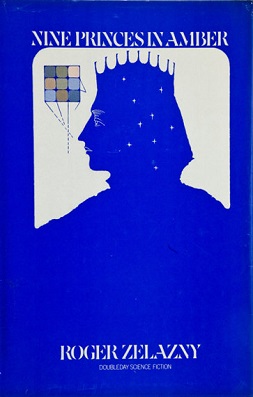
Book Review -- NINE PRINCES IN AMBER by Roger Zelazny

A man wakes in a hospital bed with no memory, except the knowledge that he's been kept drugged up for quite some time. He doesn't know why, but he's determined to escape and find out. Thus begins a fast-paced, imaginative adventure that is, in many ways, emblematic of the new wave in science fiction and fantasy. It starts off almost like a hardboiled detective novel, and indeed, there are certain character elements (including first-person narration) that seem lifted directly from a Raymond Chandler story. But it is dynamic and imaginative fantasy nevertheless.

If you haven't heard of Amber, nor read any of Zelazny's Chronicles, then I'm loath to give away any of the story. So I'll try to cut out as many of the spoilers as humanly possible while still discussing the strengths of the book.

First, the tone shifts back and forth between dense, chivalric language and modern slang, almost to the point where it can be quite jarring:
"I did not know this," I said. "My memory is so screwed up. Please bear with me. I shall miss Benedict, an' he is dead. He was my Master of Arms and taught me of all weapons. But he was gentle."
"Screwed up" right beside "an' he is dead," this mixture of wording and idiom can be somewhat shocking, but it actually makes sense, given who the protagonist is, and shows that Zelazny is actually a much more versatile writer than we think.
I walked among Shadows, and found a race of furry creatures, dark and clawed and fanged, reasonably manlike, and about as intelligent as a freshman in high school of your choice--sorry, kids, but what I mean is they were loyal, devoted, honest, and too easily screwed by bastards like me and my brother. I felt like the dee-jay of your choice.
It makes perfect sense that the protagonist's long sojourn on our Earth (and in the United States, for a time) has had a profound effect on his thinking. As the novel develops, we can see that the main character's fondness for our world has changed him on a number of quite fundamental levels. Yes, given his ultimate background, he has every reason to be haughty, superior, and to see the average person as little more than servants and/or cannon-fodder. However, his experience has given him compassion and empathy, and as he regains his memories, we learn what horrible tragedies he has seen, the wars he fought in, and the agonies he has suffered. These experiences set him apart from the others like him, and give him a deeper understanding of the "little guy."

This mixture of language styles and idioms supports the idea that the hero is caught between two lives--the one he ultimately lived in, and the one he recently experienced on our Earth (right before he awakes in the hospital bed). His character could be simply flat and static, and in many ways, he might seem so. But Zelazny's use of idiom and his subtle reminders of the protagonist's past experiences (through brief flashes of memory), as well as his compassion for underlings, creates a stark contrast between him and his peers.

Due to the brevity of the work, the other characters don't get much time to develop, but Zelazny does a good job with the barest of spaces that he uses. For example, Random lives up to his name--he's impulsive and unpredictable; Moira comes off as cool, in control, confident, and serene; Eric as hard, determined, and ruthless. Other characters, however, don't come off so well. Deirdre could be played by Random Blonde #5, and Caine and Gérard are poorly defined and very interchangeable, but they could all be much better depicted in later books. The characters are all pretty archetypal at this point in the tale, but the book is only 175 pages long so I guess it can be excused.

Zelazny is also quite light on the description, so your mental pictures are a bit smoky and ill-defined. The magnificent city of Amber only gets a brief sentence of description when seen from a distance, which will be quite surprising and perhaps disappointing to readers weaned on Tolkien or Robert Jordan.
The mountain that faces the dawn, Kolvir, which has held Amber like a mother her child for all time, stood perhaps twenty miles to our left, the north, and the sun covered her with gold and made rainbow the veil above the city.
You really don't get much more than that. Zelazny doesn't want to slow down his story for the sake of description, but that means that your mental picture is little more than a pencil-sketch without a lot of color. You have to fill in most of the image.

What Zelazny does describe are events--especially fights. The reader would be advised to brush up on some of his fencing terminology, because Zelazny uses it, frequently during sword-fights. His action is fast, bloody, and brief, but you can easily visualize the swashbuckling style that made guys like Errol Flynn famous. There is one sword-fight that takes place in a library that is only a few pages long, but is far, far more exciting than reading a Robert Jordan duel, which ends up being a list of inscrutable blade techniques with names like Lakota chieftains.

The use of amnesia and the regaining of memories serves as a great vehicle for introducing the world and the setting to the readers, rendering info-dumps as an integral part of the storyline and making them far more interesting to the reader and more emotionally meaningful to the protagonist.

Many refer to The Chronicles of Amber as Zelazny's magnum opus, and I can certainly see this being a solid foundation for such a work. The book is populated with allusions to history and literature, which make the story both familiar and new at the same time. For example, the Forest of Arden is lifted from Shakespeare's As You Like It, and there are elements of the War of the Roses infused in the rivalry for the throne of Amber. The Trumps themselves make for a great setting/story element. Each turn of the pages reveals more and more of Zelazny's mysterious universe.

Good fantasy, like good science-fiction, is often about the imagination, and the creation of believable systems that enable the writer to do whatever he/she wants. Zelazny's book is a pretty good flight of fantasy. Unfortunately, character depth isn't all that impressive for the most part, and Zelazny's lack of description is somewhat disappointing, because when he does decide to describe something, he seems to do so effectively enough:
The archway loomed ahead, perhaps two hundred feet distant. Big, shining like alabaster, and carved with Tritons, sea nymphs, mermaids, and dolphins, it was. And there seemed to be people on the other side of it.
How much does Zelazny really need to say about an archway? He sums it up with two sentences. But something like the city of Amber itself deserves a bit more. The strength of this pulpy language is to keep the story moving and keep the reader interested. But I feel as if there were areas where more description was warranted, even if it did slow down the narrative a bit. Zelazny wisely chooses to explain why Amber is so magnificent and wonderful through the actions, words, and thoughts of the character and keep the story flowing. However, we could certainly benefit from a more extensive physical description of its magnificence. I honestly must say that I have no idea what Amber is supposed to look like, except that it's on a mountain and beautiful. Maybe gold. I could tell you all about what it represents, but I really can't say a single thing about what it looks like. For something so central to the story, I feel that it deserves a bit more.

All together, this is a fairly solid, pulpy book and a decent contribution to the swashbuckling angle of the sword & sorcery genre. It's certainly a fine example of "big concept" writing (with Amber itself being the concept), and it's full of action, suspense, and atmosphere galore. Zelazny writes events and situations remarkably well, and he certainly is a master at creating atmosphere and tone, but he makes an Iphigenia of physical set descriptions in order to propel the plot forward on winds of action and suspense. Nevertheless, it is definitely recommended.

Nine Princes in Amber by Roger Zelazny
Style B+
Substance B
Overall B

Thursday, July 1, 2010

Immersion Factor and Old School

James over at Grognardia spawned a bit of discussion when he said in a recent post:

I'm not what you'd call a deeply "immersive" referee. I am big on describing things, sometimes at great length, but I don't do it in a way intended to "transport" the players into the game world. ... I prefer to maintain a distance between myself the game world and it's a distance my players maintain as well.

Then Brunomac at Temple of the Demogorgon threw his hat into the ring discussing how immersion doesn't require the players to be actors. This isn't Mind's Eye Theater, ladies and gentlemen.

I think this is one of the reasons I'll never be a very good Old School gamer. I'm very much a child of what Grognardia James calls "The Hickman Revolution." No, this does not mean that I enjoy the railroad-style DMing that Hickman presents in the Dragonlance modules. Personally, my DMing style follows more closely to what Justin Alexander calls "Node-Based Scenario Design" (although he describes it better than I could).

I'm not a fan of organic character development. Thus, the whole 3d6 rolled six times never really appealed much to me. I've done it on occasion, and I've rolled up lots of Elmer Fudd characters, some of whom survived, others who died before they hit third level. But I've never actually managed to roll up a character I could immerse myself in very often using that system.

The best characters I had ever played were ones I designed from the ground up, and ironically, they were all for the Forgotten Realms. One was a ronin samurai fleeing dishonor, another was a Mulhoarandi (read: Egyptian) priest of Thoth who believed magic resided in all of us and taught people how to draw it out of themselves, another was a halfling archeologist (read: rogue) who wanted to hoard up enough treasure to open an museum and start a university, and another was a gnome artificer (a 3rd edition prestige class) with dreams of building a time machine. These were all characters who had distinctive personalities, goals, and reasons for adventuring. Each was designed before I even picked up the dice, just through brainstorming and inspiration. Watching a movie or reading a book would spur ideas in my brain that resulted in a desire to play a certain type of character.

When I play an Old School game, the whole 3d6 thing usually results in me not being able to play anything like these characters. For example, to properly play Locke, the halfling archeologist, I would need to roll up a halfling thief (assuming we're using advanced rules where races are not classes), and pour all of his skills into opening locks and disarming traps. He'd need to have a decent dexterity (otherwise he'd have little aptitude for this sort of job), and a high intelligence (given his desire to study history and advance the profession of archeologist). The other ability scores are not that important, but one fudged roll in Dex or Int results in me not being able to play him whatsoever. How can I justify playing an archeologist with an Int of 5 or 6? It's nonsensical.

Thus, the ability to play out a character idea which had inspired you at some point prior to picking up the dice is pretty-much impractical in an Old School game. This is one inhibition towards the immersion-factor of certain players. It helps me to be playing a character I like, one I'm inspired by and can easily envision. I play role-playing games because I like to imagine doing things and seeing things that I can't in real life. I like being part of a story that is fantastic, and exerting some kind of influence over the game world.

This is also one of the reasons I love established settings, especially Dark Sun and The Forgotten Realms. I especially love The Realms because it is so heavily detailed. While some Old School DMs find the idea horrifying, I find it intriguing. The setting is alive, integrated, and whole, and it only scratches the surface. Ed Greenwood is to The Realms kind of how M.A.R. Barker was to Tékumel. Grognardia James' once commented how Barker could just transport himself to his own world and see how people interacted with one-another and come up with connections, histories, and the like. That indicates that there is a level of detail and life that exists in the game world. Because of its size and its incredible detail, I've found The Realms to be a fascinating place to visit. Unfortunately, the plethora of cheap TSR (and later WotC) novels set in The Realms inevitably tend to disappoint (with a few exceptions, like Grubb's/Novak's Azure Bonds), I usually find myself going there in daydreams or just wandering through the different supplements and sourcebooks produced by TSR. The Realms is a setting where, once, in high school, our party decided we were going to just wander around and visit different cities, seeking adventure. Literally. We wandered around, did odd-jobs (often not involving killing, believe-it-or-not), and just experienced the world.

It was in this game I got the inspiration for the "Big Score" that we never did get to pull off--set up a joint-stock company, hire a merchant ship in Waterdeep, sail it all the way to Kara-tur, load up on exotic spices from the Orient, see the sights, get into trouble, return with our cargo, and retire filthy stinking rich. No dungeons. No crawls. No stealing jewels from goblin idols. No searching rooms for traps. Just a voyage to the opposite side of the world looking for spices that would make us more wealthy than kings. We never did it, but that journey would have taken us across seas, to ports all over the world of Toril.

Yes, the Old Schooler might say, you can do that in any homebrew setting. But I beg to differ. The Realms grew out of a decade of dozens of people writing and tying disparate campaign ideas together. Boxed sets and sourcebooks piled together to create an enormous world full of thousands of cities and locales that defined the setting and brought it to life. What many gamers consider bloat, I consider depth and breadth, vitality, and a sense of realness. I do not feel nearly as inspired to try that "score" in any other world. Abeir-toril is so big and so detailed that a DM could literally turn that merchant voyage into a campaign that could last a year or more, because there are so many places to stop on the way. Just go google up some maps of Al-Qadim, Kara-tur, and Faerûn. Start from Waterdeep. Calculate distance and travel times. Roll for random encounters at sea. I guarantee that before the ship even reaches the coasts of Calimshan, the party's vessel has had at least one fight against pirates (probably out of the Nelanther Isles), made port at one or two locales on the Sword Coast or the Moonshaes, and possibly very nearly wrecked in a storm while traversing The Race. That's good for at least one or two months of solid gaming right there, and you've not even left the coasts of Faerûn, yet.

But the reason for such inspiration and immersion? Simple: Familiarity and accessibility of the material. The player cannot access all of the detailed information a DM of a homebrew setting might have. Therefore, his ability to become inspired by the setting details is limited unless the DM sets about writing a multi-volume handbook on his world. The problem is, this somewhat flies in the face of the entire system of Old School world-building in the first place.

See, Old School world-building is predicated on the dungeon. The party has a base of operations, such as a city, castle town, or village of some sort. Nearby is a dungeon for them to explore. Gradually, in a slowly widening spiral, the map of the surrounding world gets larger and the history gets filled in. Grognardia James has been excellent at describing the gradual growth and development of his setting, and I believe that his world-building is very much in-line with general Old School tendencies.

While I can enjoy that sort of game, it doesn't really scratch that itch I have for whole, complete, consistent and persistent setting material.

In addition, as a DM, I also prefer to run games based around a theme or idea, and this also is very anti-Old School. For example, I had once designed an Eberron campaign in which the party members were all to somehow be tied to Morgrave University and specifically a certain professor who vanished into the jungles of Xen'drik (kind of like Dr. Livingston). What I was after was a pulpy sort of Solomon Kane, Indiana Jones, Heart of Darkness, Tarzan, Alan Quartermain type of game, in which Xen'drik was a kind of analogue for Africa, and the characters were set to explore its darkest depths. This being said, certain kinds of characters would not have fit well with the kind of game I wanted to run. This doesn't mean I wanted to railroad the characters--on the contrary, I love giving my players free rein to pursue their objectives however they wish. But in order for the theme to operate successfully, the players have to buy into the notion that the game actually has a theme, and then create characters accordingly. This is very antithetical to Old School DMing and campaign design.

In addition, I don't actively seek to kill the characters. Danger exists in any game I DM. However, I find it more fun to see interesting stories evolve out of the players interacting with the world. I'm much more interested in seeing how they solve problems and deal with their surroundings than whether or not they can successfully make it through an ingeniously lethal dungeon. I try not to fudge dice rolls, and if characters die, they die. But I don't particularly want to run a game in which there is a certain level of antagonism between me and the players. For me, role-playing is about exploration and interaction, and is an immersive experience. Hence, while I can enjoy a good Old School game, I do prefer my games to have a certain late-1980s/early-1990s feel to them.

Wednesday, June 23, 2010

Appendix N, Nostalgia, and Contemporary Fantasy

Nearly every single gaming-related blog has a little bit to say about Gary Gygax's "Appendix N," a list of inspirational reading for players and Dungeon Masters found in the Dungeon Master's Guide for first edition Advanced Dungeons & Dragons. So, I'll probably be making reference to "Appendix N" as time goes on, much like many of those other blogs do. This isn't necessarily to copy them--it's actually kind of a necessity. "Appendix N" is the bibliography for Dungeons & Dragons as listed by Gygax himself. (What I'd give for an "Appendix N" written by Dave Arneson!)

Minus the introductory text, the reading list is as follows:


Anderson, Poul. THREE HEARTS AND THREE LIONS; THE HIGH CRUSADE; THE
Bellairs, John. THE FACE IN THE FROST
Brackett, Leigh.
Brown, Fredric.
Burroughs, Edgar Rice. "Pellucidar" Series; Mars Series; Venus Series
Carter, Lin. "World's End'' Series
de Camp, L. Sprague. LEST DARKNESS FALL; FALLIBLE FIEND; etal.
de Camp & Pratt. "Harold Shea" Series; CARNELIAN CUBE
Derleth, August.
Dunsany, Lord.
Farmer, P. J. "The World of the Tiers" Series; etal.
Fox, Gardner. "Kothar" Series; "Kyrik" Series; et of.
Howard, R. E. "Conan" Series
Lanier, Sterling. HIEROS JOURNEY
Leiber, Fritz. "Fafhrd &Gray Mouser" Series; et of.
Lovecraft, H. P.
Merritt, A. CREEP, SHADOW, CREEP; MOON POOL; DWELLERS IN THE
Moorcock, Michael. STORMBRINGER; STEALER OF SOULS; "Hawkmoon"
Norton, Andre.
Offutt, Andrew J., editor SWORDS AGAINST DARKNESS Ill.
Pratt, Fletcher, BLUE STAR; etaf.
Saberhagen, Fred. CHANGELING EARTH; etal.
St. Clair, Margaret. THE SHADOW PEOPLE; SIGN OF THE LABRYS
Tolkien, J. R. R. THE HOBBIT; "Ring Trilogy"
Vance, Jack. THE EYES OF THE OVERWORLD; THE DYING EARTH; et 01.
Weinbaum, Stanley.
Wellman, Manly Wade.
Williamson, Jack.
Zelazny, Roger. JACK OF SHADOWS; "Amber" Series; et of.
BROKEN SWORD
MIRAGE; et of.
Series (esp. the first three books)

The most immediate influences upon AD&D were probably de Camp & Pratt, REH, Fritz Leiber, Jack Vance, HPL, and A. Merritt; but all of the above authors, as well as many not listed, certainly helped to shape the form of the game. For this reason, and for the hours of reading enjoyment, I heartily recommend the works of these fine authors to you.


I've read a few of these, particularly some Zelazny, Moorcock, Howard, de Camp, Anderson, Vance, and Tolkien, to name just a few. When asked if he'd change anything, or add new media, Gygax generally responded with a "no," barring the addition of one or two new publications that have emerged since the late 1970s/early 1980s.

This is significant because it indicates that Gygax's vision of Dungeons & Dragons, and perhaps role-playing in general, evolved very little after his initial co-creation of the role-playing hobby with Dave Arneson. However, I found his comment a bit disturbing.

Essentially, Gygax all but completely ignores the emergence of "high fantasy." While this, in-and-of itself isn't surprising, because he often under-reported the influence of Tolkien on D&D, it shows a bit of closed-mindedness toward different developments in the genre of fantasy fiction. One of the major themes one cannot help but notice throughout Gygax's "Appendix N" is that not a single book in the list breaks the 250-300 page mark (with the exception of Tolkien's works). In other words, the books tend to be short, exhibit a tight economy of prose, develop quickly through rapid pacing, and are of limited scope. Indeed, some of the authors penned only short stories and novellas, never full-length novels. Gygax seemed to eschew the sort of world-shattering conflicts that were the hallmark of post-Tolkien high fantasy that emerged during the very late 1970s and became quite vogue in the 1980s.

That post-Tolkien fantasy is rife with problems, I'll admit--the greatest of which being their tendency toward overt imitation. Nevertheless, there are quite a few writers that Gygax has completely overlooked which could easily provide inspiration for a great many gamers and Dungeon Masters. A number of authors have produced some fantastic work in the past 15-20 years that deserves to be noted, but seems to have been completely ignored by many in the gaming community (particularly the "old school" community) in favor of many "Appendix N" books.

These include (but are not limited to) Steven Erikson, Ian Cameron Esselmont, R. Scott Bakker, Dan Simmons, and Tad Williams. During the 1980s, Raymond E. Feist emerged with incredible books, like his two-volume Magician and the ultra-imaginative A Darkness at Sethanon, but it appears he had almost no impact on Gygaxian roleplaying. Why is this the case?

Well, first, it is apparent that Erikson's/Esselmont's and Feist's worlds may not have an impact on roleplaying because they, themselves, originated as roleplayed settings. Nevertheless, they still deserve notice because of the magnitude of imagination that went into the creations of their worlds and the atmosphere of adventure, magic, and wonder that surrounds everything that takes place within those settings. Erikson, Esselmont, and Feist inspire me to roleplay far more than Zelazny or Moorcock. I think these authors took a lot of what inspired Gygax, and indeed took roleplaying itself, and developed it further. Like it or not, roleplaying has actually impacted fantasy literature, and I am not talking about Margaret Weis and Tracy Hickman. I'm talking about how fantasy literature and roleplaying are part of a continuum--changes in one can, should, and do impact developments within the other. It's a living and breathing system.

Fantasy writing is not, and should not be, stagnant, but should develop and change with the times. Nostalgia is great. I remember playing old school Rules Cyclopedia D&D with friends in middle school. The books we read had a massive impact on our gaming. The creation of self-contained worlds that made perfect sense wasn't as cool as having random characters and creatures from all of the different and disparate fantasy novels you've read make guest appearances. We weren't old enough to demand logic and continuity from our gaming worlds yet. As we got older, though, we started to expect settings to behave more rationally, and a bit of the magic slipped out of our play.

I still look back at those days as an awkward pre-teen playing in whimsical, Wonderland-esque games where our characters could have an ale or two at the same table as Conan, Raistlin, Elric, and Gandalf. But I wouldn't want to really play in that sort of game anymore. Nostalgia isn't now. It is a longing for things past and gone.

I think that a lot of the old school renaissance is fueled by nostalgia. In itself, I don't think it is destructive at all. I have serious problems myself with where roleplaying has gone. And I may sound a bit hypocritical when I criticize the impact of video games on table-top roleplaying when I applaud the relationship between roleplaying and fantasy literature. But I think that, in it's desire to return to the original roots, old school gamers have thrown the baby out with the bathwater in terms of fantasy fiction. There's too much of a focus on "Appendix N" and not enough of a focus on more recent sources of inspiration that can enhance and enrich one's role-playing experience.